From semi-finished products to high-performance components: DORNIER presents new solutions for 3D weaving and scalable composite series production at JEC 2026
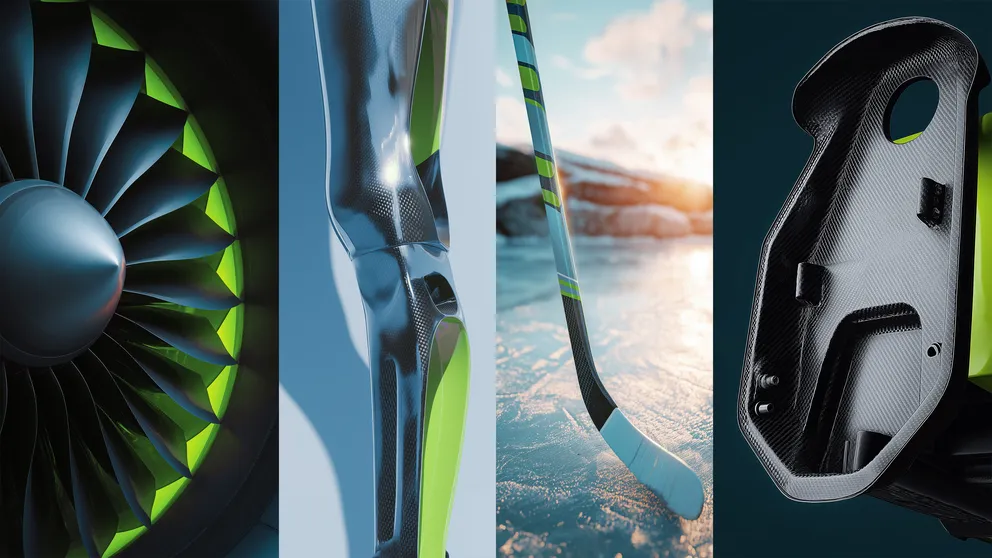
Lightweight and high-strength composites are key components for weight reduction and energy efficiency in industries such as aerospace, mobility, infrastructure, construction and energy. At JEC World from 10 to 12 March 2026 in Paris Nord Villepinte (Hall 6, Stand B71), Lindauer DORNIER will present plant solutions for the economical series production of such composites. The new TRITOS® FLEX 3D weaving technology and the expansion of the in-house technical centre for application-specific material validation will be the focus of the JEC exhibition.
TRITOS® FLEX – the flexible entry into 3D weaving
At JEC World, the world's leading exhibition for composites, the machine and plant manufacturer DORNIER will present TRITOS® FLEX, a further development of its TRITOS® (Textile Roving Into Three-dimensionally Oriented Structure) 3D weaving machine. The new line is the answer to the growing demand for complex 3D fabrics with excellent impact behaviour and high damage tolerance. “With TRITOS® FLEX, we want to enable companies to get started easily and cost-effectively in the production of 3D fabrics,” says Dr. Josef Klingele, Head of product line Composite Systems at DORNIER. The new line is primarily aimed at users who require particular flexibility in the production of 3D fabrics. While the existing TRITOS® PP line covers the economical and highly automated series production of 3D fabrics with thicknesses of up to 100 millimetres, TRITOS® FLEX can also be used to flexibly and precisely manufacture small and medium-sized series of 3D fabrics with thicknesses of up to 50 millimetres. DORNIER customers use TRITOS® systems to manufacture high-quality 3D preforms for the automotive and aerospace industries, among others.
P2 Roving and P2 Mono Roving: Weaving machines for flat roving fabrics
For the production of flat reinforcement fabrics, DORNIER is presenting the latest developments in its P2 Roving and P2 Mono Roving rapier weaving machines in Paris. These weaving machines are regarded worldwide as the benchmark for the reliable and economical processing of carbon, glass and aramid fibres. Thanks to their high insertion capacity, patented and maintenance-free drive and modular design, they can be used to produce technical fabrics – from heavy tow to the finest special fibres – particularly efficiently and reproducibly. With the new PIRO® system for gripper opening, DORNIER also offers an innovative solution for pattern-controlled optimisation of the weft transfer (“pic-a-pic").
Expanded technical centre: From matrix mix to series production
Another focus at JEC World is the PROTOS® (Polymer and Roving to Sheet) production system. It addresses the growing demand for thermoplastic composites with short cycle times and high recyclability. The system combines the production of unidirectional tapes (UD tapes) on the PROTOS® tape production line and their processing into fabrics on the PROTOS® tape weaving machine in a continuous process. In order to make it easier for customers to move into series production of highly resilient structural components made of fibre composites, DORNIER has recently significantly expanded its technical centre at its Esseratsweiler site. “Our customers test the processing of various thermoplastics into UD tapes here and validate their matrix materials before specifying the system,” explains Dr. Klingele. “This also includes high-temperature thermoplastics for high-end applications.” In addition to the tape production line, a tape weaving machine, a 3D weaving line and a P2 roving weaving machine for flat fabrics are also available for testing.
Composite Systems®: Over 50 years of experience in fibre composite manufacturing
Founded in 2014, the Composite Systems® division combines DORNIER's decades of experience in the design and construction of weaving machines and film systems. Here, systems are developed for the economical and scalable series production of tailor-made composite solutions. Customers use it to manufacture components with the desired geometry, optimal fibre-matrix mix and mechanical properties that are precisely tailored to the respective application. The roots of Composite Systems® go back to the 1970s: When the aerospace industry began to rely on fibre composites for weight reasons, DORNIER, as a partner from the very beginning, supplied specialised weaving machines for glass and carbon fibres. Lightweight components manufactured with DORNIER composite technology are now used in aerospace, automotive and mechanical engineering, as well as in medical technology and the sports industry.